Fireflies vs Gong: Which Is Right for Your Sales Team?
Fireflies and Gong are not the same kind of tool. One costs $2,280/year for a 10-person team. The other costs $28,500. Here's which one you actually need.
Most teams don't choose between these two correctly. They choose Gong because it sounds more powerful — and end up paying 12x for features they never use.
These are not the same kind of tool. Fireflies records, transcribes, and summarises your meetings. Gong does that too — but it's primarily a revenue intelligence platform built around deal risk scoring, pipeline analytics, and structured rep coaching. If you need conversation capture and CRM sync, Fireflies handles it at a fraction of the cost. If your VP of Sales needs to know which deals are slipping before the forecast call on Thursday, Gong earns its price tag. For most teams under $20M ARR, it doesn't.
Quick Verdict
Our Verdict
Winner: Fireflies for most teams. Gong only when deal intelligence is the job.
If you need reliable call capture, summaries, and CRM logging — Fireflies at $19/user/month. If your VP of Sales is running forecast calls from conversation signals and has a manager actively reviewing calls — Gong justifies the 12x price. Most teams buying Gong are using it as an expensive recorder. Most teams on Fireflies don't need more.
Feature Scores
| Feature | Fireflies | Gong |
|---|---|---|
| Meeting Transcription & Summaries | 8 | 9 |
| CRM Integration & Field Sync | 8 | 9 |
| Deal Intelligence & Pipeline Visibility | 4 | 10 |
| Rep Coaching & Call Scoring | 5 | 10 |
| Ease of Setup & Adoption | 9 | 5 |
| Cost / Value for Most Teams | 10 | 3 |
| Security & Data Privacy | 9 | 6 |
| Integration Breadth | 9 | 6 |
| Team Deployment Speed | 9 | 4 |
Meeting Transcription & Summaries
Both tools transcribe accurately. Where they diverge is in what they do with the transcript.
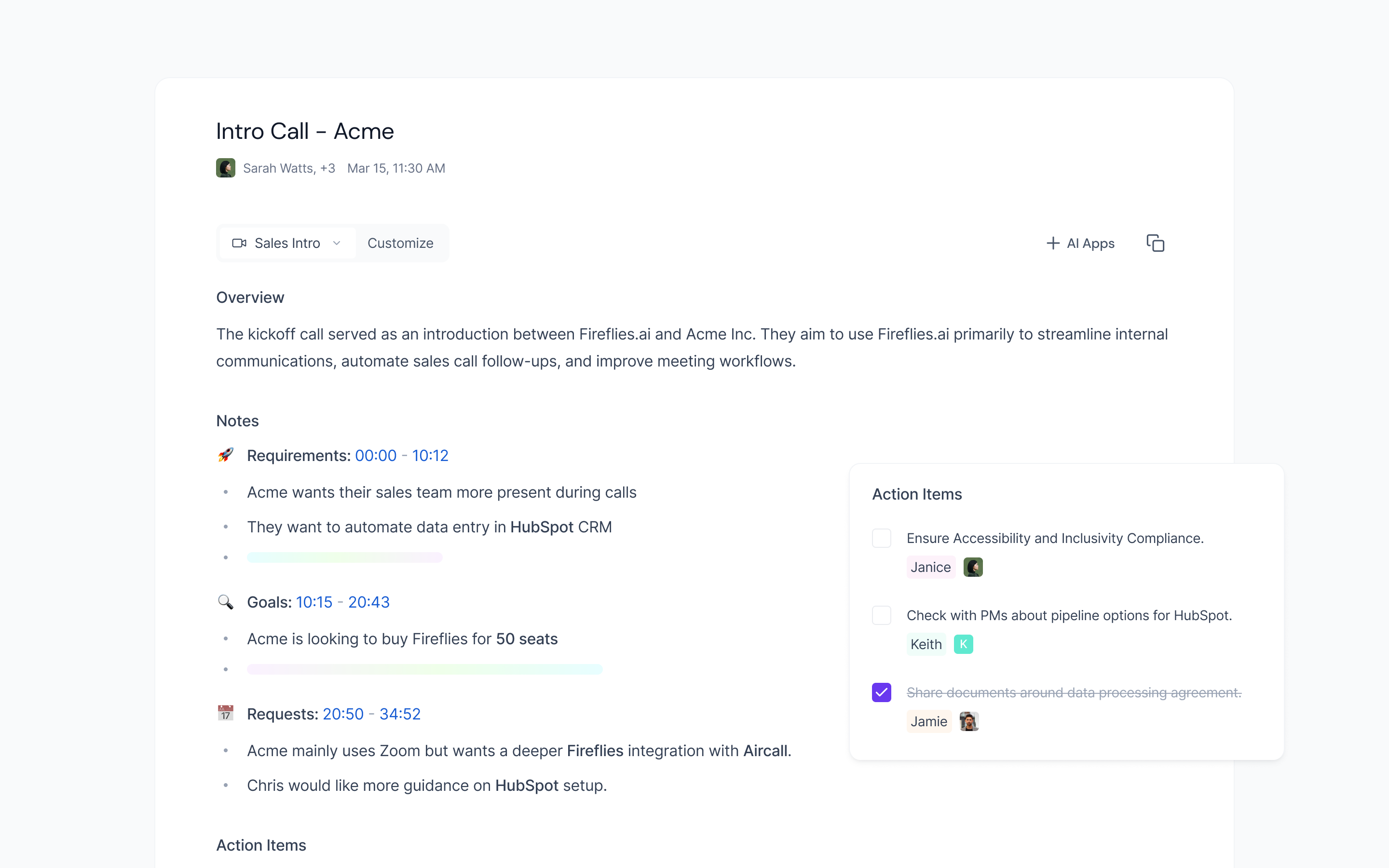
Fireflies produces solid AI summaries — action items, key decisions, speaker-tagged notes — and pushes them to Slack, CRM, and project management tools automatically. The summaries aren't perfect; on complex, fast-moving conversations, nuance can get compressed. But for most meetings, what Fireflies captures is enough to brief someone who wasn't in the room.
Gong's transcription is slightly better on sales-specific language — it handles product jargon, objection patterns, and competitor mentions with more precision because it's trained heavily on sales calls. Its Smart Trackers flag whenever a competitor or pricing term comes up mid-conversation. For a sales org trying to analyse conversation patterns across hundreds of calls, that depth matters.
Score rationale: Gong's edge is marginal for individual meeting capture. It becomes significant at scale — when you're analysing patterns across a full team's call library, not just summarising one-off meetings.
CRM Integration & Field Sync
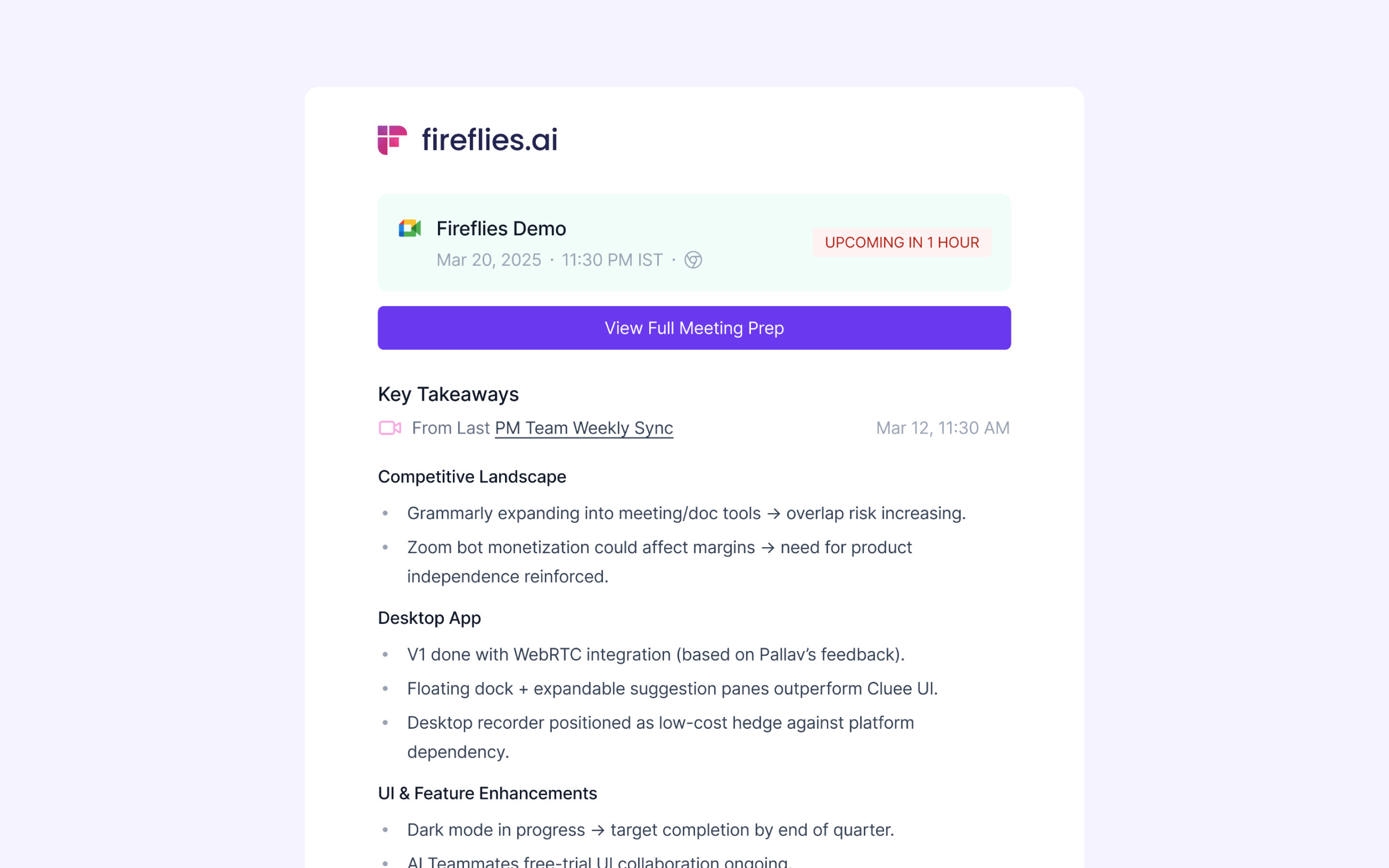
Fireflies integrates with HubSpot, Salesforce, Pipedrive, and 20+ other CRMs. It maps notes to deal records, syncs action items, and auto-associates calls with contacts. For most teams, this is more than adequate — the meeting data lands in the right place without manual entry.
Gong's CRM integration runs deeper. It writes directly to deal fields, tracks engagement signals (who spoke, for how long, how often the customer asked questions versus objected), and surfaces those signals in the pipeline view. A sales manager can look at a deal in Gong and see not just that a call happened, but whether the conversation trajectory suggests the deal is at risk.
Score rationale: If you need calls logged to the CRM, both work. If you need the CRM to tell you what the calls mean for the deal, that's Gong's territory.
Deal Intelligence & Pipeline Visibility
This is where the comparison stops being close.
Fireflies gives you meeting records. It doesn't give you a view of your pipeline health derived from conversation signals. It can't tell you that three of your top five open deals have gone quiet for 14 days, or that your close rate drops 40% whenever a legal stakeholder joins the call after the second meeting. Fireflies isn't designed to do this — it's a meeting intelligence tool, not a revenue intelligence platform.
Gong is built around exactly this. Deal boards show momentum signals pulled from call and email activity. AI flags at-risk deals before the rep knows there's a problem. Pipeline analytics show which stages have the highest drop-off and why. For a VP of Sales running a quarterly business review, Gong gives them a conversation-level view of the forecast — something no CRM alone can provide.
Score rationale: If deal intelligence is why you're reading this comparison, Gong is the only answer.
Rep Coaching & Call Scoring
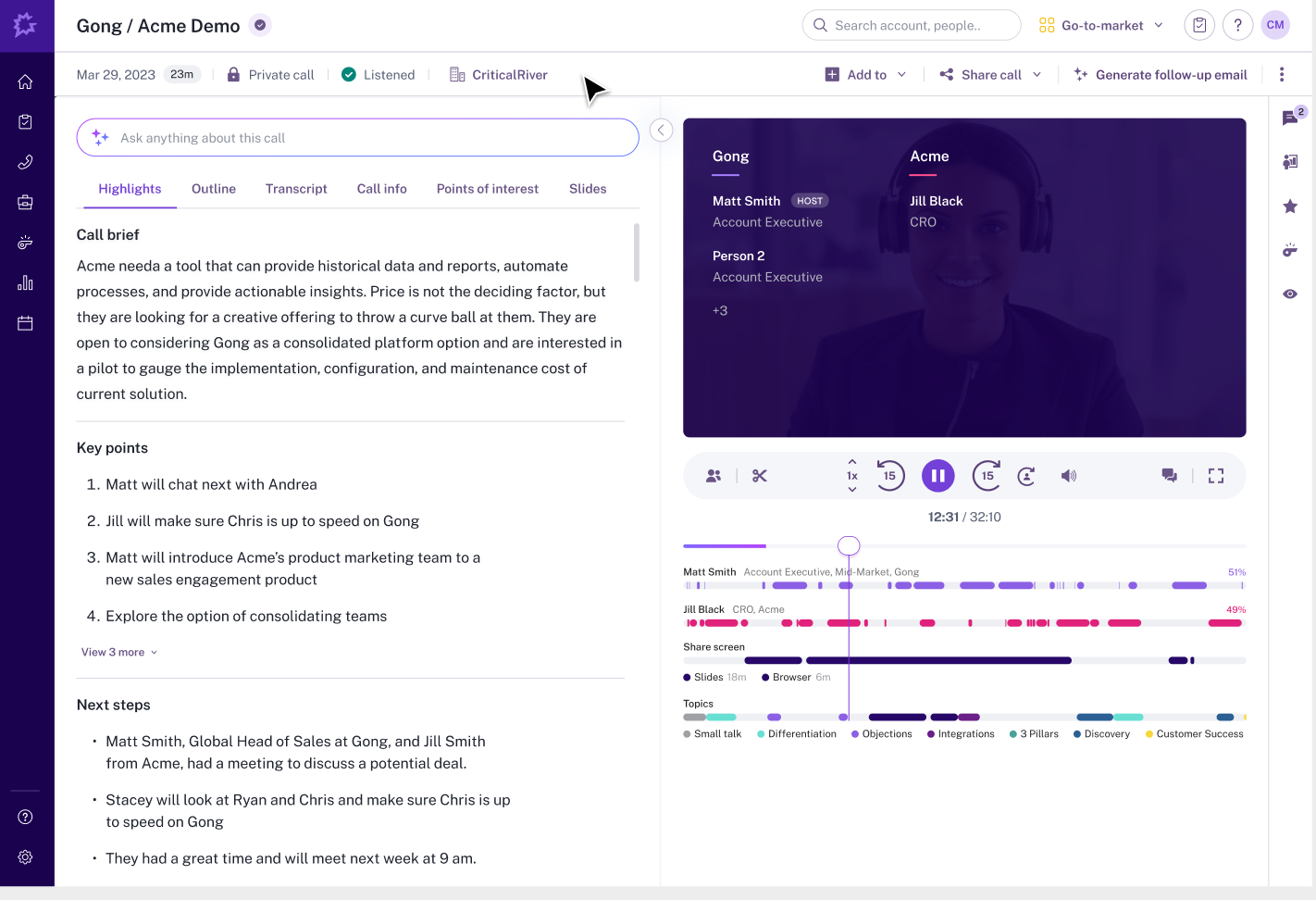
Gong's coaching module lets managers build scorecards tied to your sales methodology, review calls asynchronously, leave timestamped feedback, and track rep improvement over time. The data layer is what makes it powerful: you can see which talk tracks correlate with wins, where reps are losing deals at the objection-handling stage, and whether a new hire is improving on the right dimensions.
Fireflies has basic call analytics — talk-to-listen ratios, filler word tracking, sentiment signals. Useful for self-coaching. Not a replacement for a structured coaching programme. You can use Fireflies to flag interesting calls for manual review; you can't use it to run a scalable coaching workflow for a team of 15 reps.
Score rationale: Fireflies is good for self-aware reps. Gong is a coaching infrastructure for teams.
Ease of Setup & Adoption
Fireflies sets up in under 10 minutes. Add the Chrome extension or calendar integration, connect your CRM, and it runs in the background on every meeting. Reps don't have to change anything about how they work — Fireflies joins automatically and posts the summary to Slack when the call ends.
Gong requires a proper implementation. Expect a dedicated onboarding process ($7,500 is the standard professional services fee), CRM admin involvement, methodology configuration, and a training rollout to get reps and managers actually using it. The adoption challenge is real and well-documented: Gong buyers regularly report that reps don't engage with the coaching workflow unless sales leadership actively drives it. A Gong licence that sits unused at $1,600/user/year is not a small line item.
Score rationale: Fireflies' biggest advantage isn't the price — it's that teams actually use it.
Cost / Value
Here's the math for a 10-person sales team in Year 1:
| Fireflies Business | Gong | |
|---|---|---|
| Per-user cost | $19/user/month (annual) | ~$1,600/user/year |
| Platform fee | None | ~$5,000 |
| Onboarding | None | ~$7,500 |
| Year 1 total (10 people) | $2,280 | ~$28,500 |
| Year 2 (no growth) | $2,280 | ~$21,000+ |
Gong is roughly 12x more expensive in Year 1 for a 10-person team. That gap only narrows if Gong's deal intelligence materially improves close rates or forecast accuracy — and for that to happen, the team has to actually use the coaching and pipeline features, not just record calls.
Gong only pays for itself if you actively run coaching and pipeline reviews from it. Otherwise, it's an expensive recorder. Below $10–15M ARR, that bet rarely pays off.
Security & Data Privacy
This one matters more than most comparison pages acknowledge.
Fireflies is fully GDPR compliant, does not use your data to train its AI models, maintains BAAs with its LLM providers, and enforces a zero-day data retention policy with vendors. Gong uses customer data for AI training (opt-in), and has not publicly disclosed equivalent LLM provider agreements. Both are SOC 2 Type II compliant, but if your compliance team asks pointed questions, Fireflies has clearer answers.
Score rationale: If compliance matters, Fireflies is safer by default. For regulated industries — healthcare, finance, legal — this isn't a minor footnote.
The Hidden Variable: Your Team
Most buyers compare features. The decision that actually matters is whether your organisation is ready to use what Gong requires.
Gong fails — not because the product is bad, but because of what surrounds it — when:
- No one is reviewing calls. Gong's coaching module is only as good as the manager who uses it. If your sales managers aren't already in the habit of asynchronous call review and structured rep feedback, Gong doesn't create that habit. It just charges you for it.
- There's no enablement function. Scorecards, playbooks, and methodology configuration need someone to own them. Without an ops or enablement resource, they sit unconfigured.
- Reps resist tooling. If your team culture skews toward "just let me sell," a mandatory AI platform with coaching dashboards will generate friction from day one.
Fireflies fails when the opposite is true — when you genuinely need conversation-level signals to run your pipeline, and you have the team structure to act on them.
The test before you sign a Gong contract:
Ask your sales manager: "How many call recordings did you review and give structured feedback on in the last 90 days?" The answer tells you whether you're buying a revenue intelligence platform or an expensive recorder.
Who Should Choose What
Choose Fireflies if:
- Your team is under $15M ARR
- You need reliable call capture, summaries, and CRM logging
- You want something reps will actually adopt
- You're questioning whether Gong's coaching features are actually being used
Choose Gong if:
- You're running a scaled sales org ($15M+ ARR, 10+ reps)
- A manager is actively using the coaching workflow
- Your VP of Sales runs forecast calls from pipeline analytics, not gut feel
- You have an ops or enablement resource to drive adoption
If you're unsure, default to Fireflies. Start there, get your team using it, and upgrade to Gong when the gap in deal intelligence becomes the actual constraint — not before. Start with Fireflies here.
Keep reading
Free guide + weekly newsletter
Get Started with AI in One Day — Free
Subscribe and get our free 15-page starter guide instantly. Then weekly AI workflows, honest tool takes, and strategies for senior professionals. No fluff. Unsubscribe any time.